Hunting With Pixels’ Blog

Business Etiquette: How to get it right

· Blog

Behaving in way that is congruent with your brand and beneficial to your business is harder that you may think. How do you behave when you walk into a networking function where you know noone? How do you introduce yourself? Should you talk business straight away or have small talk first? Suit or shirt?

Here’s how you do it

Last week one of the speakers of the upcoming Short Takes event ‘Live Your Brand’ spoke at a packed Oxford Art Factory about etiquette, check it out: http://vimeo.com/39235993  

What to learn more?

Want to see Lady Danielle in action and learn more about how to connect the behaviour of you/your staff to your brand so you can really start cooking with gas business wise? Check out our video on the next Short Takes: http://vimeo.com/38760770 Our next Short Takes is on the 4th of April at the Hunting With Pixels Headquarters in Newtown. Find out more or book your ticket here.    

Curation of Social Media

· Blog

Earlier this year, we caught up for a social with the charming Andy Ellwood, Director of Business Development for Gowalla, a location-based social media group. For more info about Andy, click here. In these final two clips from our interview, Andy talks about where he thinks social media is going, and discusses how his company, Gowalla, fits into the future. Andy is not the first to suggest that social media has reached saturation point, and is now beginning to contract. He quotes entrepreneur Leonard Brody in calling this contracted social media environment the “Small Room” era. Broadly speaking, this means that instead of using our social media to interact with the entire internet, a space that is growing larger by the second, we will limit our interaction to those people who mean something to us, our friends and contacts. This will also lead to a rise in what is known as curation. Like a curator in a museum, we will arrange and display our thoughts and knowledge for our friends, and these recommendations will shape our online spaces. If this does become the norm, it will become harder for businesses to use social media to advertise. Rather than having a broad receptive audience, companies will need to form actual relationships, and only those that are able to become trusted curators will be able to thrive in the space. With this prediction in mind, Andy’s company, Gowalla, has set out to enable users of it’s location sharing software to tell a story, to share with their friends what a given space means to them, and to impart knowledge about the physical world through social media. It is this peer-to-peer system that forms the basis of Gowalla’s business model. Andy likens it to sharing your passport, with each stamp on the passport coming with a personal story attached. Hopefully, the person reading about where you’ve been and what you’ve done would take away ideas and knowledge, and share that with their friends, and on it goes. Even if the so-called “Small Room” era never comes about in the way predicted, it is still a solid business model for Gowalla, and gives a more personal alternative to the wide-band style of social media use that is predominant today. http://www.youtube.com/watch?v=s3YzTw2mjMw http://www.youtube.com/watch?v=e2Fev_rDJu4

Short Takes: How To Live Your Brand

· Blog

April’s Short Takes is all about Brand and Behaviour. With three Keynote speakers and a stage-discussion, this promises to be an interesting and enlightening evening! http://vimeo.com/38760770 This time our speakers will be presenting stories about the peculiarities of Australian business culture, as well as business etiquette, and personal branding. The word etiquette is not commonly used these days, but encompasses most aspects of social interaction in any society, and is vital in business interactions. It may sound like common sense, but how you and your staff behave sends out signals regarding your status and intentions, and it’s vital to be aware and in control of these messages. Click here to secure your spot. Here are our speakers

Michael Jones

Michael is a lecturer at the University of Wollongong, with a doctorate on management, looking at career commitment and motivation. He has been researching Australian business behaviour in relation to behavioural customs in other countries. His experience is not just based on books. After working in both commercial and private enterprise, and completing training as an Electronics Engineer with the Department of defence, Michael started his own company, employing several staff, manufacturing, importing and exporting electronic systems. Michael has been lecturing and tutoring management subjects at UoW since 2002.

Danielle Di-Masi

Danielle Di-Masi is a consultant and columnist on business etiquette and personal brand.   She is passionate about helping businesses improve their image, through guiding how staff perform and behave. Her motto is, when you are confident with business etiquette and appropriate behaviours, you are then able to concentrate on the important things in your business. Behaviour and succes are strongly connected, so it makes sense to pay some attention to this oft overlooked subject.  

Evelyn Lundström

Evelyne is managing director of First Impressions Image Training & Consulting.   She believes that in our world today, we are dominated by visual images, and are inclined to believe the evidence of our eyes. Companies invest huge dollars in corporate branding, but forget how important it is that individual employees reflect their brand values. Evelyn is a past President of, and current VP Member of Sydney Chapter Association of Image Consultants International. She co-authored ‘Executive Style’ (Prentice Hall) and is currently writing a book on ‘How Not To Do Old’ – the definitive book on ways to stay young.

So start living your brand!

So join us on at Short Takes to be inspired and gain new insights in ‘How to Live your Brand’. When: 4 April 2012 Time: 6.30 pm – 9.00 pm Where: Hunting with Pixels, Level 1, 270 King Street, Newtown, 2042 Price: $ 20.00 (including drinks and fingerfood)

Click on the link below to book:

Our Event        

Tech Startups – A Great Idea Isn’t Enough

· Blog

Earlier this year, we caught up for a social with the charming Andy Ellwood, Director of Business Development for Gowalla, a location-based social media group. For more info about Andy, click here. In these two clips, Andy talks about how technology is enabling more and more new businesses to start up, but do we really need what they’re selling? One of the things that the iPhone can claim credit for is the prevalence of ‘apps’. Through technical options, market share and ease of distribution, it is now easier than ever for your great program idea to become a reality. Likewise the proliferation of the internet and online businesses. However, before you go out and build a world-beating app or website, you have to stop and ask: “Does anyone actually need this?”. The problem is, we are missing out on the distinction between ‘can’ and ‘should’. Andy suggests that, once you have decided your great idea is technically possible, to raise your head up outside of the tech circles and have a look around. It is easy to become surrounded by like-minded people who share your enthusiasm for your product. However without interest from the wider market, your sales will be severely limited. Also, the market for new and exciting apps and programs is becoming increasingly crowded. While many ideas are targeted at a niche, the sheer noise from the many similar ideas serves to drown out all but the biggest players i.e. those not targeting a niche. If there are a dozen ideas like yours already floating around, it will not be enough to simply go after a different market. Finally, the big players, who are already established in these markets, have the power to simply squash any idea that they see as competing with them. No garage startup is going to become the next Facebook any time soon. Even Google+ is having trouble breaching this very established social media company. So, if you’ve found a way to make a bigger, better version of an idea that’s already entrenched, you had better be prepared for tough competition. The point Andy has tried to make in these clips is not that you shouldn’t try – rather, you should find the need first, and then tailor the product to match that need, instead of the other way around. And then, maybe, you’ll be the next big thing. http://www.youtube.com/watch?v=NL2oiaQTzd0 http://www.youtube.com/watch?v=D_7SKw1P6Dg

Small Business Marketing: What are your Goals?

· Blog

We recently had the opportunity to sit down with Steve Rubel, executive VP for Global Strategy and Insights with Edelman. Edelman is a global public relations firm, well known for being on the forefront of technological change. Click here for more info on Steve and Edelman. In this video, Steve talks about the methods by which a small business can best promote itself using social media. By definition, a small business does not have a large staff, least of all a dedicated marketing department. It may even be run by just a single entrepreneur. Given the large range of social media outlets, how do small businesses choose where to invest their time? The first step in generating a social media plan is to think hard about your agenda; what do you hope to achieve through your interactions? If your goal is to reach stakeholders (i.e. customers) directly, Steve suggests that it may be best to start small. Blog posts do not require regular upkeep, will reach new markets via Google searches, and will position your business as an expert in the field you write on. Alternatively, you could go for a more direct approach by actively seeking out your targets. Most social networks offer analytical tools to businesses which can let you build a profile of how your target consumers use social media. Once you have built up their profile, you can then find a way to market directly to people using those networks. Finally, if your social media objective is to generate ‘traditional’ media attention, twitter is becoming an increasingly powerful distribution tool. As mentioned earlier though, maintaining a regular twitter presence can become very time consuming. Above all, it is important that you spend your time wisely, and don’t bite off more than you can chew. By spending time learning more about your target and crafting a plan, you can focus on a social media policy that creates the maximum return. Whatever that means to you. http://www.youtube.com/watch?v=ZG3KWGxWDrU

Short Takes on the 7th of March 2012: Presenting Like The Pros

· Blog

A few years ago, I saw a presentation at a conference by Gary Bertwistle. As a director of a fast growing company I was very interested in the subject, but what really struck me was how absolutely flawless his 90 minute presentation was. The structure was easy to oversee, there was enough but not too much info, there were jokes, questions, anecdotes and Gary made it all look so easy.

How do they do that?

This short takes is about doing short presentations; How do we engage? How do we structure? How do we optimise video for slides? What about body language?

Who’s speaking?

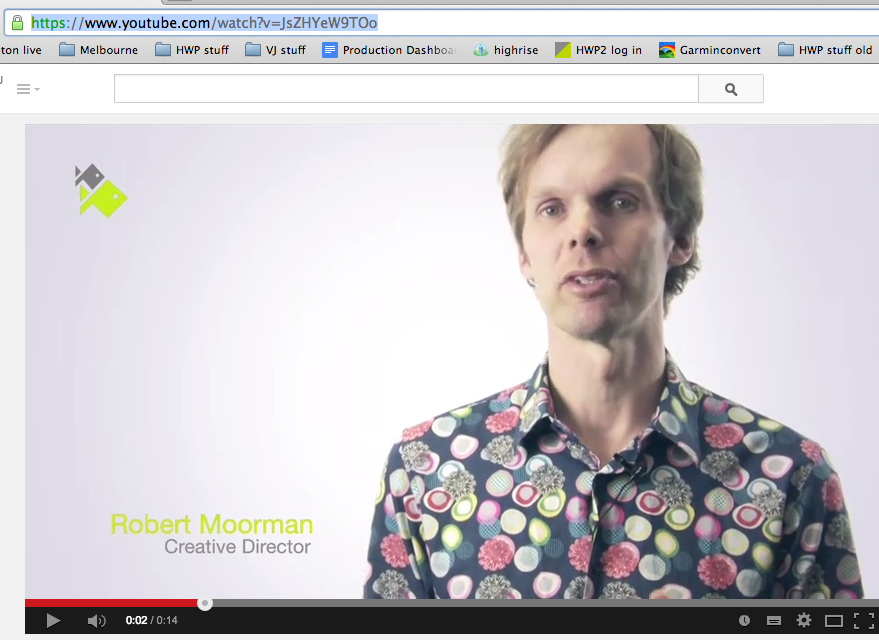
We have confirmed the following speakers: Mo Fox is talking about ‘Surfing Ambiguity’: how to deal with ambiguity in life and business. Mo is an artist and speaker with a wide range of experience in both arts and the corporate world, giving her a unique perspective on both.   Robert Moorman is talking about ‘Why Most Business Video Doesn’t Work. And What To Do About It.’ Robert is creative director with 20 years of experience creating online and mobile video. He’s got a bee in his bonnet about making video more effective. Suzanne Mercier‘s talk is called “Are your female leaders skirting Leadership or stepping up?” Suzanne is founder and CEO of Liberate Leadership, a business that helps leaders shift mindsets that block success.

When? Where?

Short Takes is on the 7th of March at the Hunting With Pixels headquarters on level 1, 270 King Street in Newtown. Doors open 18.30, we start at 19.00.

What does it cost?

This Short Takes is free, think of it as a belated ‘happy 2012’! You will have to register though. Click the link below: Our Event    

Social Media – Narcissism vs. Sharing

· Blog

Earlier this year, we caught up for a social with the charming Andy Ellwood, Director of Business Development for Gowalla, a location-based social media group. For more info about Andy, click here. In this clip, Andy discusses the way in which the ubiquitousness of social media has changed what and how we share with it. To a person from the 19th century, today’s society’s habit of sharing via social media would seem positively exhibitionist. Our notion of privacy has come a long way in a very short space of time. Andy frames it as a uniquely American trait, the church of the individual, where people are raised to believe their voice counts more than any other, and so become quite used to talking about themselves. Whether US specific or not, with the globalising influence of the Internet, we all now have the opportunity to have our voices heard, and are taking advantage. But what are we saying? In the formative days of social media, it was acceptable and common to post the completely banal into the web ether. However, doing this assumes an audience for an individual’s banalities that simply doesn’t exist. Andy suggests that if someone were to tweet about eating toast in today’s internet, they would be ridiculed. Instead, the kind of sharing that generates a positive reaction is those with greater value. Using social media to distribute genuinely useful information, or even to entertain or inspire the reader, gives justice to the term ‘sharing’. Far from an internet full of individuals talking about themselves, we then gain a network of people with overlapping interests and cross-pollenating ideas. With the explosion of social media content, it is harder than ever to stand out on the web. Those people who are genuinely sharing, who are placing online content that has value, will be heard far more than just another narcissist. And after all, isn’t being heard what we all want? http://www.youtube.com/watch?v=gJ5VXCd2Wbw

Online Video as the Ideal Communicator

· Blog

We recently had the opportunity to sit down with Steve Rubel, executive VP for Global Strategy and Insights with Edelman. Edelman is a global public relations firm, well known for being on the forefront of technological change. Click here for more info on Steve and Edelman. In these clips, Steve discusses online video as a method of communication. He explains why it provokes greater engagement, and gives examples of best practice. With the increasing democratisation of online space, it is easier than ever for anybody to have their voice heard on the web. The side effect of this is that it’s increasingly cluttered, and those seeking information online have less and less time to devote to each individual source. As a business, you want your website to draw people in, to pique the interest of casual browsers and make them actively seek more information. Steve suggests that words alone are no longer the optimal way to do this. Today’s time-poor web browser will read as little as 20% of a page before moving on, devoting between 10-20 seconds. Obviously, this is not enough time to communicate in an accurate and engaging way. Video, as opposed to text, is capable of much stronger and more ‘human’ communication. There are many visual and emotional cues that come from listening to and looking at another human being, which text misses. If the content is relevant, it has been shown to be far more engaging with viewers, with greater retention and more follow-ups. This is not to say that you need to hire Spielberg to do your website. Video can be unpolished, provided that the content and presentation fills a need of the target audience, be that information, entertainment or a service. When asked what an example of effective video communication looked like, Steve pointed to The White House official website. The US government uploaded a regular video series named The Explainer, in which a presenter used a white board to draw and explain a dry or complicated topic. If this had been presented in text form, most site viewers would fall asleep, however as a relatively low tech video it carried enough presence that these ideas were successfully communicated. http://www.youtube.com/watch?v=uF2CqqG37v8 http://www.youtube.com/watch?v=EaUpRDbco6E

Second and final pilot for the speaker showreel video

· Blog

Our first pilot shoot for our speaker reel videos was a great success, but how could it not be with speakers like Nigel Collin, Kim Seeling Smith, Adette Rosenbach Goldberg and Mo Fox?

Now it’s time for round two.

We couldn’t fit in everyone in the first round so we’re doing one more pilot at cost price. Currently we have two spots left, so if you’re looking for a great speaker showreel at cost price, let us know.

Learn from the pros

We’re also changing the format. This time we’re not only doing the presentations but also doing a Q&A around presenting skills; how do you build the story? What slides work? How should I use video in presentations?  

When? Where?

The pilot takes place on the 7th of March at the Hunting With Pixels headquarters on level 1, 270 King Street in Newtown.

Who’s speaking?

At this point we have confirmed the following speakers: Gary Bertwistle is talking about Unlocking Your Creative Mojo   Robert Moorman is talking ‘Why Most Business Video Doesn’t Work. And What To Do About It.’   Mo Fox is talking about ‘Surfing Ambiguity’: how to deal with ambiguity in life and business.  

So what does the speaker showreel video look like?

Here’s Kim’s video: http://vimeo.com/34933864

What does it cost?

This is a showreel filmed with four broadcast level cameras; a shoot like that would cost you thousands, but by pooling the resource with three other speakers you can cut the cost to under $ 1000,- The pilot is even better value; we can offer this package for $ 695,- provided we can use it for promoting the package, how does that sound? Here’s a video with some more info:

So let’s move up the foodchain now!

Contact us to secure your spot and get a super slick, TED style showreel at cost price that you can send your clients and speaking agencies. This is as good as it get people!                

Video and multimedia; It’s like Lego…

· Blog

Earlier this year, Hunting With Pixels caught up with Shay David from Kaltura on the New York leg of our epic interviewing spree. Kaltura are a leading open-source video platform, helping business and educational clients deliver top quality video solutions. In the final section from our chat with Shay, we bring the ideas of open source and apply them to online video. Shay talks about his own business, Kaltura, and how they use the principles of crowdsourcing to deliver quality products for the end user. When we look at the future of the internet, it is clear that it will be dominated by video and multimedia. Shay predicts that in 10 years from now, video will equate 90% of the internet. However, we still have some way to go. The technology, while advancing in leaps and bounds, is still in its infancy. There are no established business models or examples of best practice, and online video remains very expensive to do well. It was these problems that inspired Shay and his partners to found Kaltura. Using their passion for open-source systems, they aim to make a big difference in the online video industry. In comparing open-source video to some of the existing (proprietary) solutions currently available, it helps to think of a trip to a toy store. The proprietary video system is the expensive doll, flashy but inflexible, and bound for the bottom of the toybox once the novelty is gone. Open source video, on the other hand, is more like lego, base functional parts which can be used in a variety of ways depending on the need. No matter the client, by leveraging their open-source video infrastructure Kaltura is able to custom build new solutions to unique problems, without having to start from scratch each time. Another advantage to using open source video is that Kaltura are able to use their large and passionate community to further aid in development. It is this passion for collaboration and creation that defines the open-source movement. By building up software that is open and flexible, Kaltura enables the next generation of internet entrepreneurs to use online video, and have created a successful business of their own. It’s the ultimate win-win situation. http://www.vimeo.com/25701162